Software commerce
How to Run a Software Reseller Program (2026): Portals, Debt & Pricing
Multiply software sales with a professional reseller program. Partner portals, per-product permissions, reseller pricing, debt limits and HWID-bound keys — all in PapelShip.
At some point, other people want to sell your software for you. They run communities, speak other languages or simply have customers you will never reach directly. A software reseller program turns those people into a sales channel.
Done badly, it also turns into spreadsheets of keys sent over chat, partners who never pay and licenses nobody can trace. This guide covers how to structure a reseller program so partners can sell on their own while you keep control of pricing, keys and money.
The old way: sending keys in bulk
Many sellers start by generating a few hundred keys and sending them to a partner. It feels simple, but it creates problems:
You lose track of which keys were sold, to whom and when.
Unsold keys are a liability; if they leak, they still work.
Payment is based on trust and manual reconciliation.
A partner who disappears takes your keys with them.
A better structure
A modern reseller program gives each partner a portal where they generate keys themselves, only for products you allow, at prices you set and within a financial limit you control.
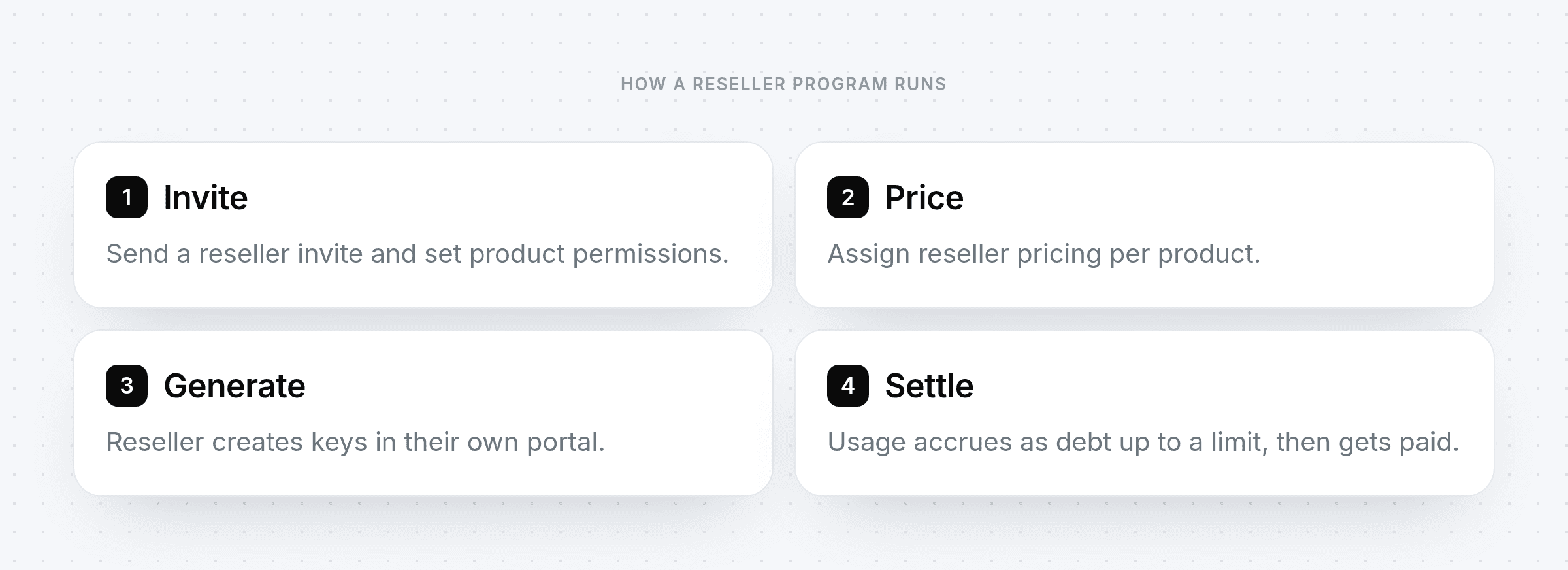
1. Invite resellers
Send an invite instead of sharing your own account. Each reseller gets their own login to a reseller portal with keys, computers, account settings and API access.
2. Set per-product permissions
Decide exactly which products and durations each reseller may sell. A new partner might start with a single product; a trusted one can carry your whole catalogue.
3. Define reseller pricing
Resellers usually buy at a discount and sell at your retail price or their own. Set reseller prices per product so every key they generate is charged correctly.
4. Let resellers generate keys
When a reseller makes a sale, they generate the key in their portal or through the reseller API. Keys are created on demand, so there is no stockpile of unsold keys waiting to leak.
5. Control exposure with a debt limit
Instead of prepaying, the reseller accrues a balance as they generate keys. You set a debt limit and a grace period: once the limit is reached, generation pauses until the reseller pays. Your risk is capped at a number you chose.
Prepaid credit vs debt limit
Prepaid credit | Debt limit | |
|---|---|---|
Reseller cash flow | Must pay before selling | Sells first, pays within limit |
Your risk | None | Capped at the limit |
Friction for new partners | High | Low |
Best for | Unknown or one-off partners | Growing, trusted partners |
Many programs start new partners on a low limit and raise it as they prove reliable.
Keeping licenses under control
Keys generated by resellers are normal licenses in your system. That means everything you use for direct sales still applies:
HWID binding stops a reseller key from being shared.
Bans work on any key, regardless of who generated it.
Device visibility shows where reseller keys are running.
Attribution tells you which reseller created which key, so problems can be traced back.
Rules that keep a program healthy
Publish minimum prices so resellers don't undercut your own store into the ground.
Start small with new partners: one product, a modest limit.
Review monthly: volume, payment behaviour and refund or abuse rates per reseller.
Make support responsibilities explicit: who answers the customer, and when it escalates to you.
Remove access cleanly when a partnership ends; keys already sold keep working, new ones can't be created.
qPapel Auth Sell licenses online HWID locking
Frequently asked questions
Do resellers need access to my dashboard?
No. Resellers use their own portal and only see what you allow them to sell.
Can resellers automate key generation?
Yes. Resellers can generate keys through an API, which lets them plug your products into their own stores or bots.
What happens when a reseller hits the debt limit?
Key generation pauses until they settle their balance. Keys already issued continue to work.
Can I see which reseller sold a key?
Yes. Reseller-generated keys are attributed to the reseller who created them.
Grow through partners, not spreadsheets
A reseller program should feel like adding salespeople, not adding bookkeeping. With portals, permissions, reseller pricing and debt limits, partners can sell independently while every key stays traceable.


